The DIscovery and Journey of the Casein Free, HFCS Free, Artificial Color Free diet

Our Journey: The Casein Free, HFCS Free, Artificial Color Free diet .

Tuesday, May 17, 2011

Sungrubbies and Foil for my Sunscreen!

Before I write this particular blog - I want to give you my favorite sunscreen so you don't have to rush through the reading and look for it below... what? You think it's funny!? I do it all the time :) Come on - desperate mom's are always rushed and need quick answers... so here is mine :) 
(We have officially finished the "testing" phase.. and SO FAR SO GOOD! no mood "triggers" or other issues. I use it myself and LOVE it!)  It seems expensive ($20) a bottle BUT it is almost 3 Times the amount you get for natural sunblock at Whole Foods which can cost ($17+) !!! So you are actually spending less that you would for a mainstream sunblock with all of the TOXIC stuff in it at the local grocery store. Pretty Cool eh?
Sunscreen - Sun Stuff from Purple prairie
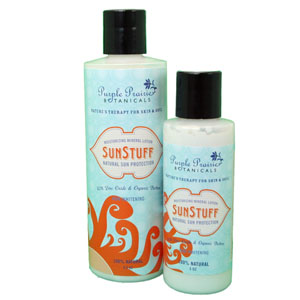
99% natural ingredients:
active ingredient: 20% micronized zinc oxide. non active ingredients: aqua(water), organic cold pressed olea europaea(olive)fruit oil,hamamelis virginiana(witch hazel) kosher vegetable glycerin, organic cocos nucifera (coconut),Behentrimonium Methosulfate, Cetyl Alcohol, Butylene Glycol organic, butyrospermum parki (shea butter), organic theobroma cacao (cocoa butter), organic jojoba oil,rosemary extract


For my impatient friends out there (you know who you are!) : The link to the website where I purchase my girls' cute sunproof swimsuits is at the bottom of the page.

Who remembers going to the beach (or pool - for you non-coastal people) and having your mother spread that white paste all over your nose and cheeks? Just me? Come on - admit it... We all had the pleasure of looking like a bunch of clowns in the 80's when it came to sunscreen :)

But sometime in the mid 90's EVERYTHING changed.... at least from my point of view.  It seemed like the numbers got higher and higher and the ingredients became chemicals... hmmmmm...

I bought a book (10 years ago) about toxins in the home and read it in one night. It scared me!  One of the books "big draws" was it's information and research on OXYBENZONE in sunscreens.  My first thought was, "why would I want to put any type of fuel product on my skin?!". My second thought was, "great, it's back to clown face for me".

If you spend some time researching how sunblock works you'll come this very oversimplified explanation. There are 2 basic kinds of sunscreen:
1.) Those which absorb into your cells and tell them not to turn red.
2.) Those that act like a layer of foil covering your skin and reflect the rays off.

For me, this basic information is enough to influence my decision. I don't want anything altering the normal process of my cells.  It's FOIL FOR ME!

If you want some "proof" of my conclusions I can't give it to you definitively, but I can cut-n-paste a websearch response below...

"Oxybenzone is a chemical in the family of benzophenones that is used in the vast majority of common sunscreens, as well as other skincare products, lip balm, etc. It is in the majority of sunscreens because of its ability to absorb and dissipate UV light, which causes sunburn and eventually skin cancers. Ideally, the chemical would simply sit on the skin and block sun rays until being washed off. Unfortunately, a study from the CDC suggests that the chemical is actually absorbed into our system, and can stay there for an unknown amount of time. The CDC randomly tested thousands of blood samples and found traces of benzophenones in 95 percent of the samples. It is certainly a scary thought that this chemical is being absorbed into our systems and causing unknown effects.
Currently, there are no studies showing a direct relationship between oxybenzone in sunscreen and negative health consequences. However, there is evidence that benzophenones can cause damage to cells and affect hormones in a lab setting. This means that if you expose animal cells to oxybenzone in a lab, you may see toxic effects. The caveat is that this does not always translate into cellular damage in the real world, usually because the concentration of the substance is much higher in lab studies. Many commonly used substances have been shown to cause cancer in rats, most famously the artificial sweetener aspartame. I think the most important thing is to wear some type of sun protection, oxybenzone-containing or not, because we know for a fact that sunburns and sun exposure leads to skin cancer. Playing it safe, however, is never a bad idea."

Skin Biology website has a great page to read.(I highly recommend reading this one!) 

I like this link because it also explains a VERY important topic - the affects of too many "estrogens" in our daily life. And YES, chemical sunscreens contain estrogen-like compounds that confuse the body.

Here are some chemicals to watch out for in your sunscreen ingredient list (also on the above site):


Benzophenones (dixoybenzone, oxybenzone)
PABA and PABA esters (ethyl dihydroxy propyl PAB,  glyceryl PABA, p-aminobenzoic acid, padimate-O or octyl dimethyl PABA)
Cinnamates (cinoxate, ethylhexyl p-methoxycinnamate, octocrylene, octyl methoxycinnamate)
Salicylates (ethylhexyl salicylate, homosalate, octyl salicylate)
Digalloyl trioleate
Menthyl anthranilate
Avobenzone


If you are desperate and traveling - and NO WHERE near a natural food store etc...
 I only found one option:
 It is the LESSER of the EVILS....

Active Ingredients:
Titanium Dioxide 4.9%, Zinc Oxide 4.7%

Inactive Ingredients:
Alumina, Arachidyl Alcohol, Arachidyl Glucoside, Ascorbic Acid (Vitamin C), Avena Sativa (Oat) Kernel Extract, Beeswax (Apis Mellifera), Behenyl Alcohol, Benzyl Alcohol, BHT, Bisobolol, Butylene Glycol, Butyloctyl Salicylate, Cetyl Dimethicone, Dimethicone, Dimethicone PEG 8 Laurate, Dipotassium Glycyrrhizate (Licorice Root), Disodium EDTA, Ethylhexylglycerin, Glyceryl Stearate, Hydroxyethyl Acrylate/Sodium. Inactive Ingredients: Acryloyldimethyl Taurate Copolymer, Isohexadecane, Methicone, Methylisothiazolinone, Pantothenic Acid, PEG 100 Stearate, PEG 8, Polyaminopropyl Biguanide, Polyhydroxystearic Acid, Polymethylmethacrylate, Polysorbate 60, Potassium Sorbate, Retinyl Palmitate, Silica, Stearic Acid, Styrene Acrylates Copolymer, Tocopheryl Acetate, Triethoxycaprylylsilane, Trimethylsiloxysilicate, Trisiloxane, Water, Xanthan Gum
Please note that this is the easiest sunblock to find if you are out in town, on the road, traveling, etc... and only have a walmart/target at your disposal.  I will add some natural food store brands later.


Also NOTE that sneaky little sucker - BHT in the ingredients. It pops out at me and has a whole lot of nastiness in those three little innocent looking letters. BUT, sometimes we have to go with the lesser of two evils.  And so I do...

Now,  on a daily basis, if my girls are out playing or going to the pool/beach etc... I simply put these COOL swimsuits on them (Here are the ones for older girls size 6+).  I LOVE them.. and I can attest that after spending one summer in the pool 5 hours a day for 6 days a week (why do pools always close one day for maintenance!?) They still looked like little Caspers :)
And these sunhats fold up nicely in your purse/bag/cargo shorts pocket etc... for those theme park adventures when your kids are waiting in line etc... we are wearing then in ALL of our Disney photos! They are a cool material that dries quickly - so your kiddos can wear them in the pool and walk around with them 5 minutes later. Also great on a hot day (get them wet in a water fountain before putting them on!)

 Here is the SunGrubbies website (click on me!)


The staff is kind. And, the last time i checked, you can still talk to a human when you call! 


Sunday, May 15, 2011

Artificial color can float and fly?


I have moved my blog to another page. Please visit me here!


Carrie


First of all - every child is different. BUT, having said that, usually children who have a sensitivity to artificial color  internally (eating it) will also have some reaction to it being inhaled thru their nose or absorbed thru their feet and hands during an art class. (Or playing outside with sidewalk chalk)

FYI  I am now completely convinced that Tempura paint is HIGHLY airborne!!! Mae had a horrible episode last month when she sat over a pile of tempura paint mixed with shaving cream during art class. The very next morning I had coffee with a friend who informed me that her cousin is allergic to artificial color and is a painter. When she paints with tempura paint she must wear an aspirator. Problem solved. Case closed. From now on - Mae uses watercolors (to which we have had no reactions to inhaling indoors with little ventilation). IF we have to use tempura, we do it outside!!!

I found these gloves online that she now wears during art class to prevent the glues, paint, markers from getting on her skin.


I'm not sure that wearing them for a long time is healthy, but the alternative is unacceptable. Mae likes the pretty colors they come in - pink, purple, orange, and blue. And no need to worry about Mae feeling different or embarrassed in art class - MOST of the other kids beg to have a pair as well!!! 

I found them at Madison art store. Let me know if you find them cheaper!

Friday, May 13, 2011

Week 1: Things to watch for...


Here are few things that come immediately to mind -  some of which I missed the first week.

Toothpaste
Sunblock (I'm working on a blog for this!)
Hand soap (bathrooms)
Dish soap
Dishwasher soap (it leaves a film on the dishes)
Laundry detergent
Shampoo
Sidewalk chalk (on hands and inhaling)
Fingernail Polish (I am going to reintroduce this for trial)
Play-do (make your own!)
Painting (any art project that gets color in contact with skin - wear gloves!)
Stick-on tattoos
Children's medicine
(I'm sure I'll think of more as soon as I go to bed!)


Travel with your own hand soap. Public restrooms almost always use colored soap. And even if it looks white 9 times out of 10 it has color in it! This goes for hand sanitizer as well. I don't trust ANY of the main brands. I make my own. (half Aloe Vera Gel, half 93+% alcohol ; I add some Young Living Essential oils to mine)


A positive note: Although in the beginning it took around 5 days to for her body to rid itself of one molecule of artificial color, HFCS, or casein... I can honestly say that now (after 16 months on the diet) it is more like 12-24 hours recovery time. So it did get better for us!

Kosher Parve and/0r Vegan = Casein Free?

Before you read the following - please know that just because a product says Vegan or Kosher Parve - it does not guarantee that they are casein free with regard to a serious allergy.  I would, however, trust them with a casein sensitivity until proven otherwise (possible cross contamination).

I came across this randomly yesterday..  I know that Vegan usually means that a food is safe and free of Casein.  But now i can add Kosher Pareve / Kosher Parve to my list!

So, as I stumbled onto this strange symbol "Kp"  on a box  I began researching. I am a professional "digger".  Thanks to a college friend (who knows exactly who she is!) I am now  a "bunny trail-er" a.k.a. one who finds themselves wandering off the beaten path. I used to heckle her for constantly getting off path. Now I'm right there with her :)

Back to the story at hand... here is some basic info about Kp:

"The Jewish laws of kashrut (koshering) demand a number of dietary restrictions. For our purposes, the wonderful thing about kashrut is that milk and meat may not commingle. Therefore, kosher foods fall into three categories:


  • MILK: products which contain dairy or dairy derivatives or are processed on equipment which has processed dairy-containing products,


  • MEAT: products which contain meat or meat derivatives or are processed on equipment which has processed meat-containing products,


  • PAREVE: products which contain neither meat nor dairy, nor their derivatives, nor are produced on equipment which has processed meat or dairy products.

  • Hormone issues

    Sorry it took so ling to finally post this  - for those gal pals out there who have been asking:) 

    I had a history of Ovarian Cysts and Migraines (around periods) until a year and a half ago :)
    I became hooked on Young Living Essential Oils . [Mainly "Thieves" - but that's another story!]
    They sell a product called Prenolone Plus with DHEA.

    IT ROCKS!!!!!!!!
    After 2 months of use (21 days a month - you stay off for the 7 days of your menstrual cycle) I had no more migraines and was Cyst Free as long as I was on it. These little tubes seemed endless. One tube would last me around 3 months. No Kidding.  I simply used a spot the size of little "pea" and rubbed it in every night before bedtime. You can research it more online, however, I broke down and bought the book that Gary Young (the creator of YL oils) wrote himself. Ever had your very own "witches brew" desk reference? No? hmmm.. well I have my own now.  It's called The Essential Oils Desk Reference


    I can research every essential YL sells AND look up "Recipes" of oil mixtures for ailments of any kind:) I just checked on the web and it seems to be so popular right now that it's out of stock or available for a rather ridiculous amount. Those of you close to me are welcome to borrow mine :)

    It says to rub the cream on at least 3 different places on your body (ex: Monday-inner thigh, Tuesday-Belly, Wednesday-inner arm etc... then repeat)

    Hope this helps!

    Friday, May 6, 2011

    List of Casein Ingredients to watch for


    I have moved my blog to another page. Please visit me here!


    Carrie

    Here is a list I have compiled so far:

    Artificial butter flavor
    Butter
    Butter fat
    Butter oil
    Buttermilk
    Casein (casein hydrosylate)
    Caseinates (in all forms)
    Cheese
    Condensed milk
    Cottage cheese
    Cream
    Curds
    Custard
    Dry milk
    Evaporated milk
    Ghee
    Goat’s milk
    Half & Half
    Hot dogs
    Lactalbumin
    Lactalbumin phosphate
    Lactic acid starter culture (may contain milk)
    Lactoferrin
    Lactoglobulin
    Lactose
    Lactulose
    Low fat Milk fat
    Lunchmeat
    Magnesium caseinate
    Malt
    Malted Milk Margarine Milk (in all forms including condensed, derivative, dry, evaporated, goat’s milk, and milk for other animals, low-fat, malted, milkfat, non-fat, powder, protein, skimmed, solids, whole)
    Milk cheese lactose
    Milk powder
    Milk protein
    Milk solids
    Naturlose (sweetener derived from whey)
    Non-dairy creamer butter
    Nonfat milk
    Nougat
    Powdered Milk
    Pudding
    Rennet casein
    Sausage
    Skim milk
    Sodium lactylate (may or may not contain casein)
    Sour cream
    Sour cream solids
    Sour milk solids
    Tagatose (sweetener derived from whey)
    Whey in all forms (including sweet, delactosed, protein concentrate)
    Whole milk
    Yogurt

    Pasta with "Iron Lactate" as an ingredient?!?!?

     as I was about to pour a new bag of pasta in the boiling water, I reread the ingredients (a habit) an noticed IRON LACTATE ?!?

    I am currently researching it - so if you know more about it please comment. So far it seems like a new form of iron where they bond a whey(casein) protein to an iron molecule to prevent it breaking down and tasting like metal when mixed with Vit C products (such as Red Pasta sauce)..

    I have stopped using it completely.  And will get back when I find out more :)

    This is why I ALWAYS read the ingredients.  Even if I have been using the product for months!!!

    UPDATE: It DOES have Casein.